
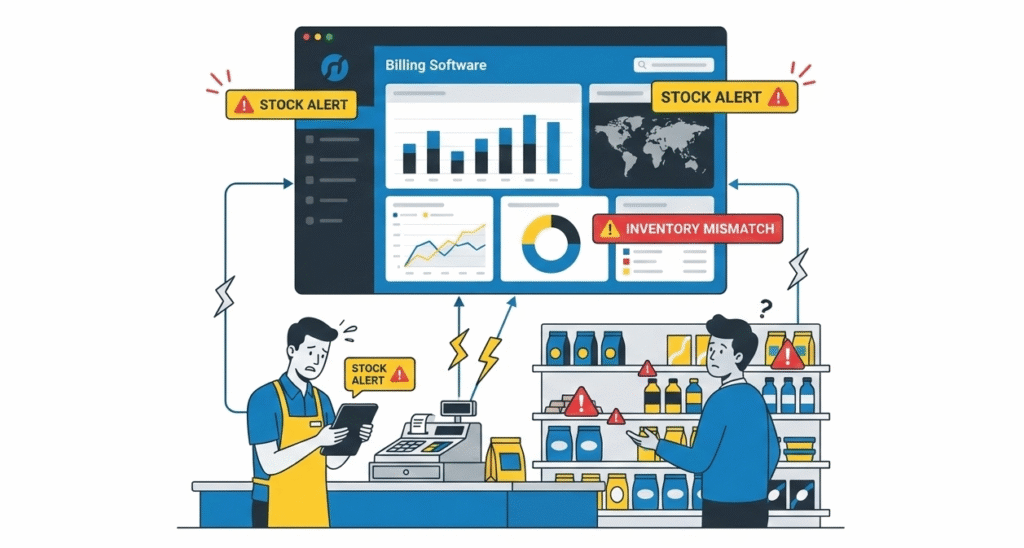
For many Indian retailers, adopting billing software feels like a major operational upgrade. Invoices become faster, GST reports are easier, and daily sales tracking improves.
Yet despite using billing software, many businesses continue to struggle with stock mismatches, lost sales, and inventory confusion.
This raises an important question:
If billing software is in place, why do inventory problems still exist?
Billing Solves Transactions — Not Inventory Reality
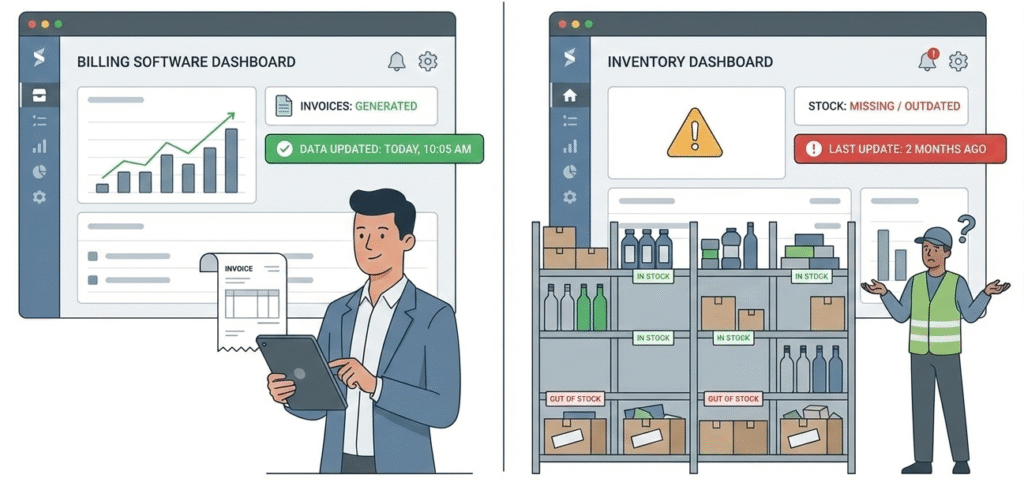
Billing software is designed primarily to record sales transactions. Its job is to generate invoices, calculate taxes, and track revenue.
Inventory control, however, is a different challenge altogether.
Most billing tools:
- Update stock only at the point of sale
- Ignore stock movement outside billing (returns, damages, transfers)
- Lack of real-time synchronization between the store, godown, and purchases
As a result, what appears “available” in the system often does not reflect reality on the shelf.
The Hidden Gaps That Create Inventory Issues
Indian retail businesses commonly face inventory gaps such as:
- Manual stock updates after billing hours
- Separate tracking for purchases and sales
- No visibility into slow-moving or fast-moving items
- Stock data is dependent on staff memory rather than systems
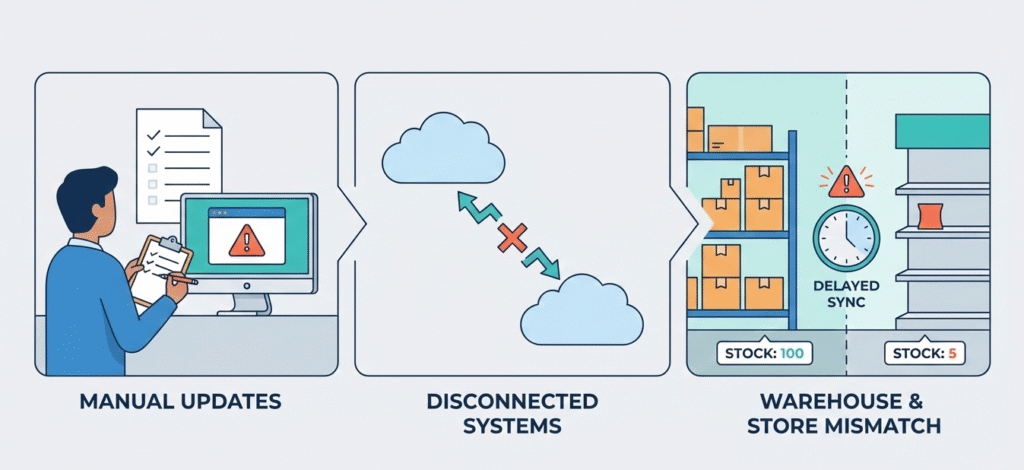
Over time, these gaps compound — leading to overstocking, understocking, and customer dissatisfaction.
Why Inventory Accuracy Matters More Than Ever
Retail operations today are more complex than ever:
- Higher SKU counts
- Faster customer expectations
- Multiple suppliers and price changes
- Increasing compliance pressure
In this environment, even small inventory inaccuracies can lead to:
- Missed sales opportunities
- Excess working capital is locked in stock
- Inconsistent customer experiences
Businesses are now realizing that inventory errors cost far more than the software meant to manage them.
The Shift Toward Integrated Billing and Inventory Control
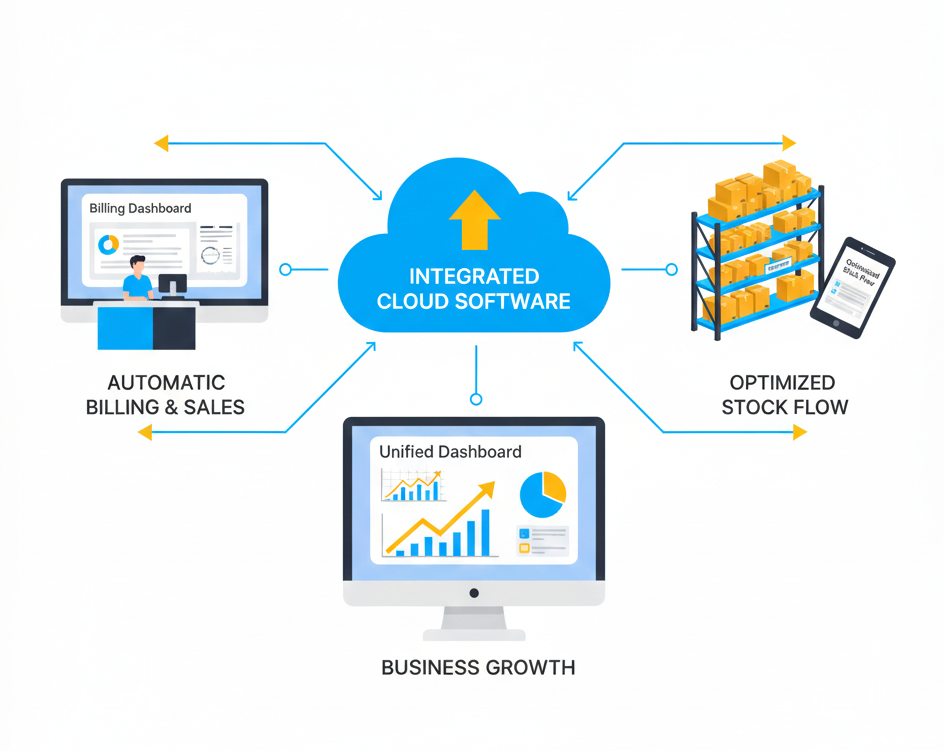
Forward-looking retailers are moving beyond billing-only systems and toward integrated billing + inventory platforms.
These systems ensure:
- Every bill automatically updates stock
- Purchases, returns, and transfers stay synchronized
- Inventory visibility across counters and warehouses
- Cleaner reporting without manual intervention
The goal is not complexity — it’s clarity.
Final Thoughts: Control Comes From Integration
Billing software is an essential starting point, but it is not the finish line.
For Indian retail businesses aiming to grow steadily, inventory control must move from manual tracking to system-driven visibility.
When billing and inventory work together, businesses gain:
- Better decisions
- Fewer surprises
- Smoother daily operations
Ultimately, technology should reduce friction — not create new blind spots.
Smart Billing. Global Growth.